
- The real purpose of signals
- The full range of signals
- Indicators — the most misused signal
- Brake lights as a signal
- Headlight flashing — one purpose only
- The horn — a last resort, not a rebuke
- Hazard warning lights
- Arm signals
- Courtesy signals
- Interpreting others' signals
- Summary — the advanced driver's checklist
The Real Purpose of Signals
Ask most drivers what a signal is for and they'll say "to let others know I'm turning." That's true, but it's only part of the picture. Signals serve a far broader role: they communicate your presence, your intentions, and in some cases your understanding of what another road user has done for you.
At the advanced driving level, signalling is woven into the System of Car Control (IPSGA) — the methodical framework used by police drivers and advanced motorists. The "I" in IPSGA stands for Information, and that information flows in both directions: you take in information from the road, and you give information back through your signals. A well-timed, well-chosen signal is an act of active driving, not a reflex.
"Signals inform other road users of your presence or intentions. Don't just consider those you can see — also consider road users you can't see and those you may reasonably expect to appear."
Roadcraft — The Police Driver's Handbook 2025That last point is critical. Advanced signalling isn't reactive — it's anticipatory. You signal for the cyclist who is about to emerge from behind a parked van, for the child who may step out between cars, for the driver behind who hasn't yet realised you're slowing. Signalling is how you narrate your intentions to an audience you may not fully be able to see.
Give a signal whenever it could benefit another road user — including those you cannot yet see. But think before you signal: indiscriminate signalling creates noise and confusion, not clarity.
One important point to internalise early: a signal does not give you any right of way. It is information, not instruction. Putting on your indicator before a lane change does not mean the lane is yours — it means you are communicating an intention. You must still ensure the manoeuvre is safe.
The Full Range of Signals Available to You
Most drivers habitually use only two signals: indicators and brake lights. Advanced drivers consciously deploy a much wider toolkit. Here is the full range available in a standard vehicle:
Indicators
Direction intention — the most frequently used and most frequently misused signal.
Brake Lights
Speed reduction — often overlooked as a deliberate communication tool.
Headlight Flash
Presence signal only — widely misunderstood and frequently misused.
Horn
Presence warning — a last resort, never a rebuke or a command.
Hazard Lights
Stationary hazard warning — with strict rules about use while moving.
Arm Signals
Supplementary direction signals — rarely used but important in specific situations.
Courtesy Signals
Acknowledgement and thanks — underused but powerful for road harmony.
Vehicle Position
Your position on the road is itself a signal — it tells others what you intend to do.
That last item — vehicle position as a signal — is one of the most powerful concepts in advanced driving and one that most drivers never consciously think about. When you position your car correctly for a right turn, you are already communicating your intention to observant drivers behind you, before your indicator even goes on. Position and signal should always reinforce each other, never contradict.
Indicators — The Most Misused Signal on the Road
Indicators are the signal most drivers use most often, and yet they are routinely used too late, too briefly, cancelled too early, left on too long, or omitted entirely. Advanced drivers approach indicators with discipline and deliberate thought.
Give the signal in good time
An indicator that appears at the same moment as the turn is useless. It tells road users what you are already doing, not what you are about to do. The purpose of a signal is to give others enough time to respond. On a busy road that may mean signalling several seconds before the junction. At higher speeds, further in advance still.
One signal — one manoeuvre
This is a principle often stated and rarely understood. If you need to move left and then turn left, signal for each manoeuvre in sequence. Do not use a single left indicator to cover both. Each phase of driving deserves its own clear communication.
Check your signal stays on
Modern indicator mechanisms are sensitive and they don't always self-cancel — particularly after a shallow turn or when exiting a roundabout onto a road that curves in the same direction as the exit. Make it a habit to check your indicator has cancelled. A ghost indicator is a source of serious confusion for other road users.
At roundabouts, your indicator is only useful when paired with the correct lane position. A left signal while in the wrong lane tells other drivers nothing meaningful — or worse, misleads them. Position must confirm what your signal says.
Never treat an indicator as proof of intention
When waiting to emerge from a side road, many drivers pull out the moment they see an approaching vehicle's left indicator. This is one of the most common causes of junction collisions. An indicator means a driver intends to turn — it does not mean they will turn. They may have forgotten to cancel a previous signal, or be parking just before the junction. Always look for corroborating evidence: a reduction in speed, a change in position, visible movement of the steering wheel.
✓ Do
- Signal every time another road user could benefit
- Signal clearly and with sufficient advance notice
- Check the signal has cancelled after manoeuvring
- Ensure your position supports the meaning of your signal
- Use one signal per manoeuvre
✗ Don't
- Signal as an afterthought at the point of turning
- Assume a signal gives you right of way
- Trust another driver's indicator without confirmation
- Use a single signal to cover two manoeuvres
- Signal when it could confuse road users it isn't meant for
Brake Lights — A Signal, Not Just a Consequence
Most drivers experience their brake lights as a side-effect of braking. Advanced drivers think of them as an active communication tool.
When you anticipate a hazard ahead and begin braking early, you are doing two things simultaneously: slowing your vehicle, and warning the driver behind you that something is changing. This is particularly important when the vehicle behind is following too closely, or when road conditions may delay their reaction. Starting to brake earlier than strictly necessary — when it is safe to do so — can be a deliberate act of communication.
Avoid the habit of "dabbing" the brakes — light, repetitive taps that produce a flickering effect. This pattern communicates nothing useful and may desensitise the driver behind to your brake light signals. Apply brakes progressively and with purpose.
In electric and hybrid vehicles, brake lights may activate during regenerative deceleration — even with your foot off the accelerator. Be aware the car behind may not understand why you appear to be slowing. Allow extra following distance and brake gently and early to give clear signals.
One often-overlooked interference: rear fog lights. Because fog lights are brighter than brake lights, having yours on when conditions don't warrant it can mask the signal your brake lights are giving. Turn off fog lights as soon as visibility improves.
Headlight Flashing — One Purpose Only
No signal is more misunderstood on Irish roads than the headlight flash. It has acquired an informal vocabulary that has no basis in the Rules of the Road: "you go," "thank you," "I'm letting you in," "I'm angry." None of these are legitimate uses of a headlight flash.
The headlight flash has one purpose and one purpose only: to let another road user know you are there.
-
1On a motorway or high-speed road: flash to make your presence known when approaching from behind at speed, where a horn signal would not be heard.
-
2During darkness: flash when approaching a hill crest, narrow bridge, or winding road where oncoming drivers may not see you until the last moment.
-
3Replacing the horn at night: use a headlight flash where a horn would be inappropriate — for example, in a built-up area late at night where a horn would disturb residents.
Never interpret a headlight flash from another driver as an instruction to proceed. They may be signalling their own presence, warning of a hazard ahead, or simply misusing the signal. Always make your own independent assessment of whether it is safe to proceed.
Drivers have been involved in serious collisions after treating a headlight flash as permission to pull out of a junction — only to find the flashing driver was communicating something entirely different, or communicating with a different vehicle altogether.
The Horn — A Warning, Never a Rebuke
The horn is the most emotionally loaded signal available to a driver. Used correctly it is a valuable safety tool. Used incorrectly it is an expression of frustration — a distraction that can provoke exactly the conflict it appears to protest.
The Rules of the Road are clear: use the horn only to warn other road users of your presence when you have good reason to believe they are unaware of you. It is not a tool for:
- Expressing displeasure at another driver's actions
- Demanding that another driver moves faster
- Greeting someone you know on the roadside
- Announcing your departure from a driveway
In practice, the horn is best used as a genuine last resort — when a vulnerable road user (particularly a child or cyclist) has not seen you and is moving into your path, or when you are approaching a blind summit, narrow bridge, or single-track road where a vehicle may emerge with no time to stop.
Electric vehicles are significantly quieter than petrol or diesel cars, particularly at low speeds. Pedestrians — especially those using headphones, or children — may not hear you approaching. Be more proactive about using the horn gently in pedestrian environments.
When you do use the horn, adjust the duration to the situation. A brief, gentle note to alert a cyclist who is drifting is very different from a sustained blast. The note should communicate urgency proportionate to the risk — no more, no less.
Hazard Warning Lights — Use with Discipline
Hazard warning lights serve one primary purpose: to signal that your vehicle represents a hazard — typically because it is stationary in or near the road. They are the signal you use when you have broken down, when you are performing an emergency stop, or when you have stopped in an unusual position.
There is one legitimate use while moving: on a motorway or unrestricted dual carriageway you may flash hazard lights briefly to warn vehicles behind of a sudden slowdown or queue ahead — particularly when visibility is limited and you have encountered the hazard with little warning.
Do not use hazard lights while driving in heavy rain or fog, or for any other reason. When hazard lights are on while moving, they suppress your indicator signal — making it impossible for other drivers to know which direction you intend to turn.
Arm Signals
Arm signals are prescribed in the Rules of the Road (pages 112–113): three for traffic behind you (moving out or turning right, turning left, slowing down or stopping) and four for a pointsman and oncoming traffic (turning right, turning left, going straight on, slowing or stopping). In everyday modern driving they are rarely used, and many drivers don't recognise them.
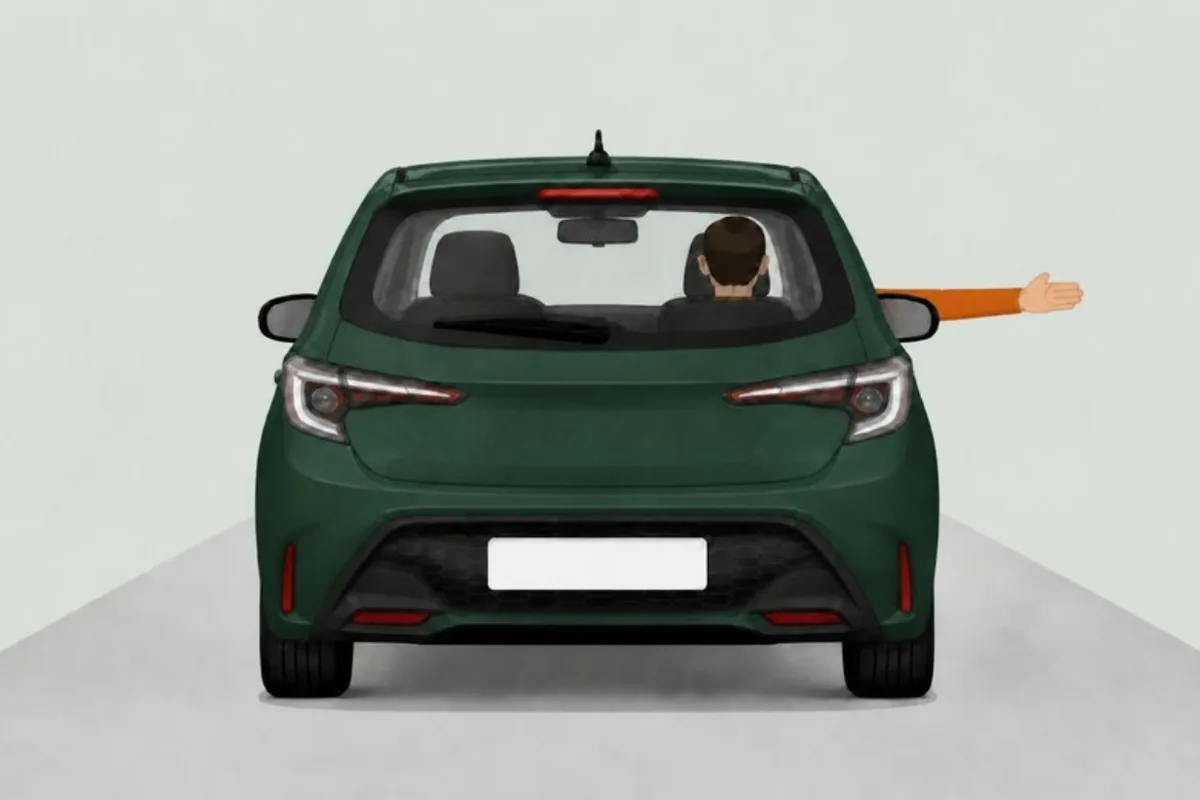
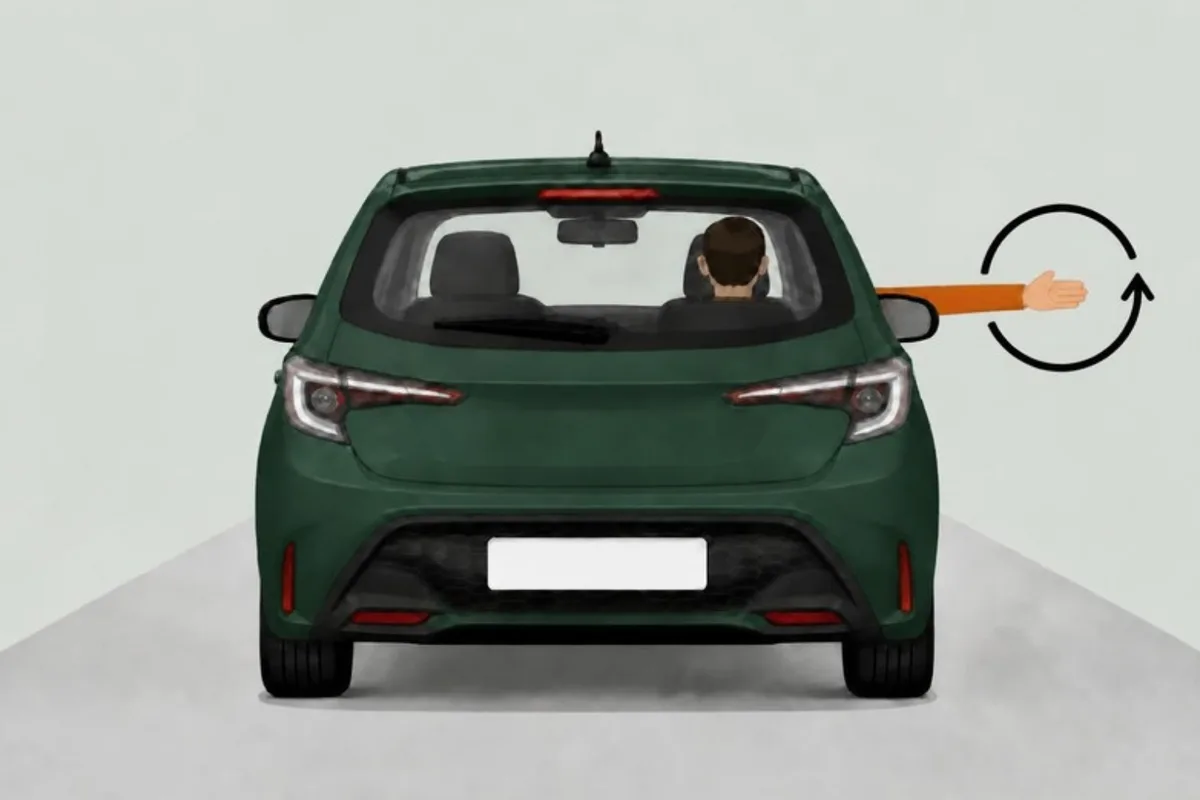
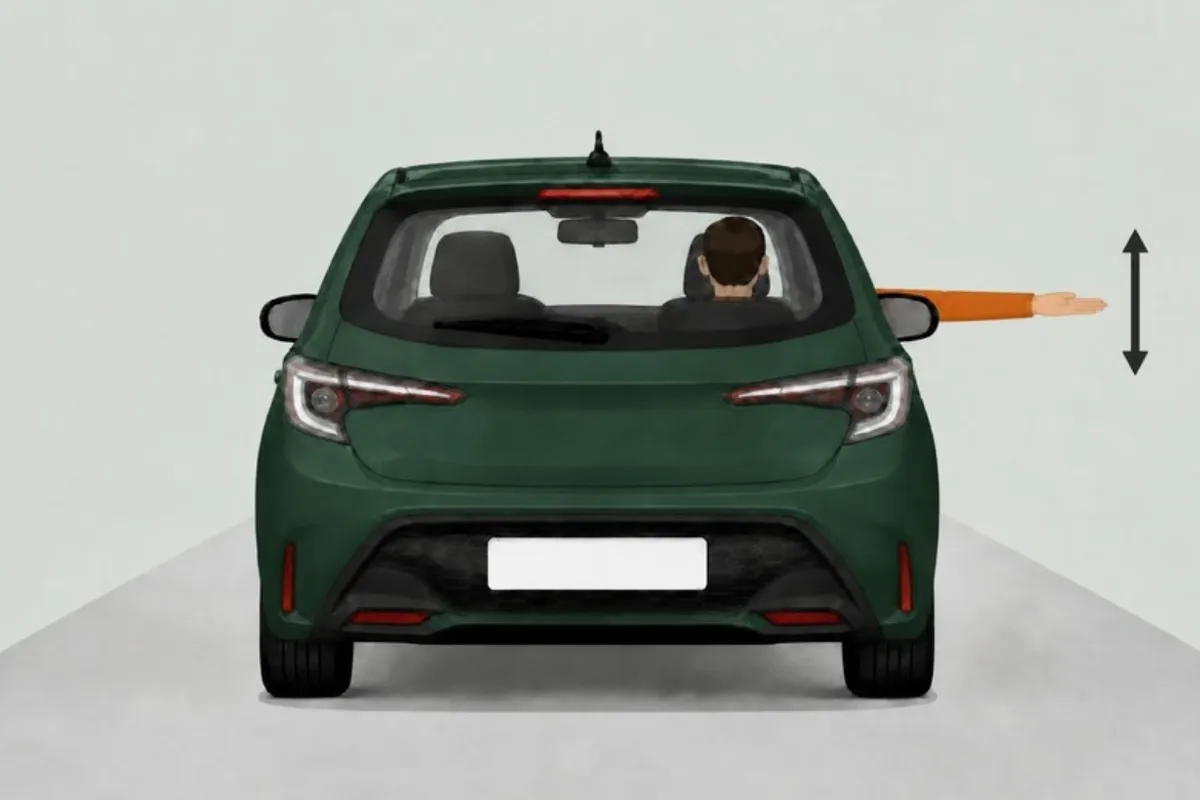
Their value today is in the situations the Rules of the Road lists (page 111): when you believe another road user may not be able to see your flashing indicators, when your indicators may not be working, or when your brake lights may not be seen or may not be working. They can also help, for example, when turning right just after moving out to pass stationary traffic on the left, or to show oncoming traffic that you intend to give way at a pedestrian crossing. If you give an arm signal, make it clear and deliberate, and be aware that many drivers may not understand it, because arm signals are rarely used (Roadcraft, 2025).
Courtesy Signals — The Most Underused Signal of All
The courtesy signal — a raised hand, a nod, an acknowledgement — is arguably the most powerful signal available to a driver, and the least used. It costs nothing. It takes a fraction of a second. And it creates a positive feedback loop on the road that has a measurable effect on how other drivers behave.
Advanced driving frameworks actively encourage courtesy signals because they:
-
1Acknowledge that another road user has been considerate — reinforcing the behaviour and making them more likely to repeat it
-
2Defuse potential tension when you have caused minor inconvenience, intentionally or not — a wave of apology changes the dynamic immediately
-
3Create a more cooperative road environment, reducing the frustration and aggression that contribute to dangerous driving
"Using a courtesy signal to defuse a potential conflict can make a real difference to road safety."
Roadcraft — The Police Driver's Handbook 2025A courtesy signal does not require removing your hand from the steering wheel. A raised palm, a brief nod, or — if you have a passenger — asking them to acknowledge on your behalf is sufficient. The key is that it is clearly a thank you, not something that could be mistaken for a waving-on signal.
Interpreting Other Drivers' Signals
The advanced driver does not take signals at face value. Every signal from another road user is treated as information — useful, but requiring corroboration before you act on it.
Consider a vehicle ahead showing a left indicator. Does it mean:
- The driver is about to turn left at the junction ahead?
- They intend to park just past the junction?
- They forgot to cancel the signal from a left bend half a mile back?
- Their indicator has stuck on without their knowledge?
The signal alone cannot tell you. Only when you combine it with vehicle position and speed — and observe actual evidence of turning intent such as slowing, repositioning, or wheels beginning to turn — can you make a confident judgement.
The same caution applies to headlight flashes and hand signals from third parties beckoning you forward. If a driver or pedestrian signals for you to proceed, you are still responsible for the decision. They may not be able to see everything you need to see. Always make your own independent assessment.
Summary — The Advanced Driver's Signal Checklist
On your next journey, apply these seven principles consciously:
-
1Ask "who benefits?" before every signal. If nobody benefits, don't signal. If anyone — including unseen road users — might benefit, give the signal.
-
2Signal early and clearly. The purpose of a signal is to give others time to respond. Late signals are noise, not communication.
-
3Let your position reinforce your signal. If your car's position contradicts your indicator, other road users will trust the position over the signal. Make them match.
-
4One signal, one manoeuvre. Do not use a single signal to cover two separate actions.
-
5Verify signals from others. Never act on a signal alone — look for supporting evidence of intent before you commit to a manoeuvre.
-
6Use your horn and headlight flash for presence only. Neither is a permission slip, a greeting, or a form of protest.
-
7Give courtesy signals freely. Acknowledge consideration from other road users. Apologise when you've caused inconvenience. It costs nothing and changes the road environment around you.
An advanced driver's signals are always timely, appropriate, and unambiguous. They treat every signal as part of a conversation with the road — not as an admin task to complete before a manoeuvre. The goal is that other road users always know what you are doing and why, without having to guess.
Ready to build advanced driving skills?
Explore our full Advanced Driving series — IPSGA, Commentary Driving, and more. All grounded in Roadcraft 2025.